Article Summary
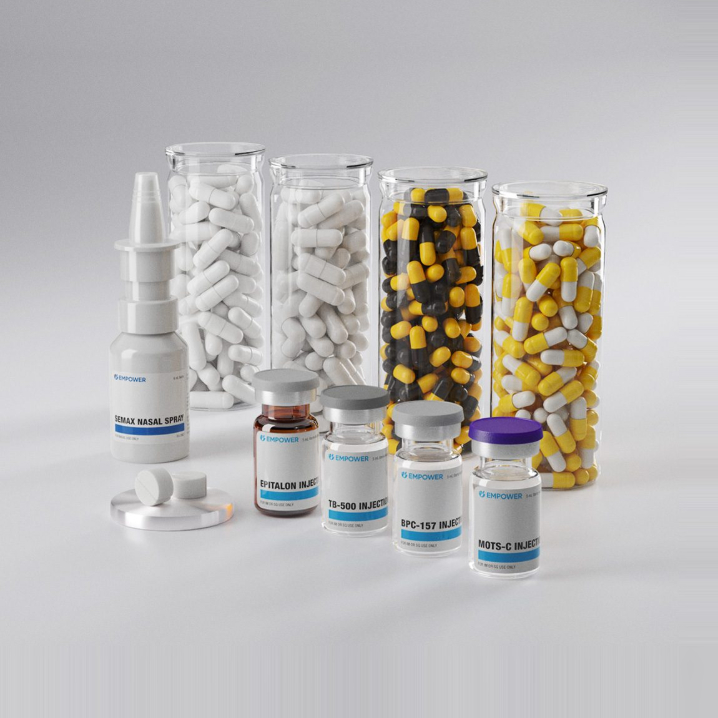
This page is a quick reference for the six peptides named in the U.S. Department of Health and Human Services (HHS) enforcement discretion policy. For each one, it shows the salt form and routes the policy lists, and what falls outside it. It covers scope only, so you will not find doses, uses or benefits here.By Katherine Bowles, PharmD
Last reviewed: November 6, 2026
At a glance: what the HHS policy covers HHS’s enforcement discretion policy names six peptides: BPC-157, TB-500, KPV, MOTS-c, Epitalon and Semax. What counts as covered depends on the exact salt form and route listed for each one, not just the peptide name. It is an enforcement policy, not an FDA approval.1 |
Which Peptides Does the HHS Enforcement Discretion Policy Cover?
Six peptides: BPC-157, TB-500, KPV, MOTS-c, Epitalon and Semax. Each is covered only in the salt form and routes that Appendix B lists, which you will find in the table below. If a peptide is not in Appendix A, or you are looking at a different form or route, it falls outside the policy.1
Peptide form and route coverage
| Peptide | Form covered | Routes covered |
|---|---|---|
| BPC-157 | Acetate | Intramuscular, oral, subcutaneous, topical |
| Epitalona | Acetate | Intramuscular, subcutaneous |
| KPV | Acetate | Oral, topical |
| MOTS-c | Acetate | Intramuscular, subcutaneous |
| Semax | Free base | Intranasal |
| TB-500b | Acetate | Intramuscular, subcutaneous |
a Appendix B specifies that injectable Epitalon acetate be dispensed in intermittent courses.
b Appendix B describes TB-500 as a fragment of the parent protein thymosin beta-4; the policy does not name the full-length protein.
Plain terms: if a peptide, form and route combination is not in this table, the policy does not cover it.1
How to Read the Matrix: Form and Route
Every row in the table tells you what the policy covers, and nothing more. The columns are not dosing or administration instructions, and they are not prescribing advice. Whether a compounded peptide is the right fit is a clinical decision made patient by patient.
- Form. The salt form Appendix B names for the peptide. Appendix B defines each substance by its exact sequence, formula and counter-ion, so acetate and free base count as different substances under the policy.1
- Route. The route of administration for which Appendix B says enforcement discretion is appropriate. Think of it as describing the covered dosage form, not telling you how to use a product.1
What “covered” means: a row in the table means the policy covers that peptide, form and route. HHS does not intend to take enforcement action when the pharmacy meets every condition. That is not an FDA approval.1
Which Peptides and Preparations Are Not Covered?
Anything outside Appendix B is outside the policy. That includes peptides not named in Appendix A, salt forms or routes Appendix B does not list, blends, and research-use-only products. The seventh peptide the advisory committee reviewed, Emideltide (DSIP), was not recommended, so it is not covered.2
- Peptides not named in Appendix A. The advisory committee did not recommend Emideltide (DSIP) at its July 23-24, 2026 meeting, and the policy does not include it.1,2
- Forms and routes not listed. For example, injectable KPV, injectable S and intranasal BPC-157 are not listed. The same goes for any salt form other than the one Appendix B names for a peptide.1
- Blends and stacks. The policy addresses single-ingredient products only, so a product that combines two peptides falls outside it.1
- Research-use-only products. The policy applies only to compounding that meets its conditions. HHS describes it as a more controlled alternative to certain research-use-only peptides from foreign manufacturers.1
- Compounding that misses a condition in the policy. Enforcement discretion applies only when every condition is met.1
Wondering whether the policy reaches 503B outsourcing facilities? The prescriber guide covers it.
What Conditions Do Pharmacies Have to Meet Under the Policy?
Here is the short version: HHS will exercise enforcement discretion when the guidance is followed. The guidance covers the peptide itself, how the ingredient is sourced and tested, how the product is prescribed and labeled, and what the pharmacy reports.1
Want the full walkthrough, including what to ask a pharmacy? See the HHS Peptide Enforcement Discretion: A Prescriber’s Guide.
Is the HHS Peptide Policy Permanent or an FDA Approval?
No. HHS describes the policy as interim, and it may revisit it, including if a safety signal or product quality issue comes up. It is not an FDA approval, and it does not add any peptide to the 503A bulks list. State boards of pharmacy and medicine set their own rules.1,3
Compounded drugs are not FDA-approved, which means FDA does not review their safety, effectiveness or quality before they are marketed.3 None of the six peptides is on the 503A bulks list; FDA decides that through rulemaking.4
Sources and How We Verified This Matrix
How we sourced this: Every coverage entry comes from Appendix B of the HHS policy and the Federal Register notice of availability.1,3 We checked each form and route in the matrix against that text. Date last verified: November 4, 2026.
Verify at the primary source
HHS’s policy is interim and may be revised or withdrawn. State laws and board rules may differ. Confirm current status with HHS, the Federal Register notice, FDA and your state boards before making prescribing or compliance decisions.
New Peptide Preparations Are On The Way
About the Author
Katherine Bowles, PharmD, is a Medical Affairs Communication Specialist at Empower Pharmacy, where she leads efforts to translate complex clinical data into clear, accurate, and compliant communications that support providers in delivering individualized patient care. She has more than two years of experience in Medical Affairs, including a postdoctoral fellowship in medical communications and publications.
References
- US Department of Health and Human Services. HHS enforcement discretion policy regarding 503A compounding using certain peptide bulk drug substances, including Appendices A and B. Accessed November 4, 2026. https://www.hhs.gov/sites/default/files/hhs-503a-peptide-enforcement-discretion-policy-appendix-b.pdf
- US Food and Drug Administration. July 23-24, 2026: meeting of the Pharmacy Compounding Advisory Committee. Accessed November 4, 2026. https://www.fda.gov/advisory-committees/advisory-committee-calendar/july-23-24-2026-meeting-pharmacy-compounding-advisory-committee-07232026
- US Department of Health and Human Services. Enforcement discretion policy regarding 503A compounding using certain peptide bulk drug substances; notice of availability. Fed Regist. 2026;91(209):68526-68527. Published October 30, 2026. FR Doc 2026-22192. Docket HHS-OASH-2026-0496. Accessed November 4, 2026. https://www.federalregister.gov/d/2026-22192
- US Food and Drug Administration. Bulk drug substances used in compounding under section 503A of the FD&C Act. Accessed November 4, 2026. https://www.fda.gov/drugs/human-drug-compounding/bulk-drug-substances-used-compounding-under-section-503a-fdc-act
Get Peptide Updates. Sign up on the Peptide Resource Center for policy and availability updates. Related: HHS Peptide Enforcement Discretion: A Prescriber’s Guide. |
Disclaimer
Compounded products are not FDA-approved and have not been evaluated by the FDA for safety or efficacy. Compounded products from our 503A facility are available only through a valid patient-specific prescription from a licensed prescriber and are prepared by a licensed pharmacy; shipping and state restrictions may apply. Compounded drug products from our 503B facility are only available for order by licensed healthcare providers and pharmacies. This document is for educational and informational use by healthcare professionals. It is not medical, legal, or regulatory advice, and it is not a promotion of any product. Except for products identified as currently available, it is not a statement of product availability.
Regulatory status
HHS’s interim policy is an expression of enforcement intent under stated conditions; it does not approve any product, change the requirements of the FD&C Act, or place any substance on the 503A Bulks List, which requires FDA rulemaking. PCAC recommendations are advisory. No dose of this product has been established as safe or effective in humans. State boards of pharmacy and medicine independently regulate compounding and prescribing. Regulatory status can change; confirm current status with FDA, HHS, and applicable state authorities before relying on this summary.
Reporting
Healthcare professionals and patients are encouraged to report suspected adverse events and product quality concerns to FDA MedWatch (fda.gov/medwatch; 1-800-FDA-1088).