Key takeaways from the HHS peptide enforcement policy
|
If you have wanted to start prescribing peptides but held off because of the regulatory environment, you are in good company. The question we hear most is, “Can I start prescribing now?” This guide covers all of the most frequently asked questions around what HHS did, what pharmacies must do, and what still rests with you, the prescriber.
Two terms first. (1) Section 503A of the federal Food, Drug, and Cosmetic Act (FD&C Act, codified at 21 U.S.C. § 353a) is the part of federal law that covers pharmacies compounding for individual patients.1 (2) Enforcement discretion means HHS has announced its intent not to pursue enforcement action it could otherwise take, if specified conditions are met. The U.S. Department of Health & Human Services (HHS) is the federal regulatory agency that houses the U.S. Food & Drug Administration (FDA). The FDA, along with other state and federal authorities, regulate compounding pharmacies.
HHS Peptide Policy Timeline
Here is how we got here and what each step meant for prescribers.
| When | What happened | What it meant for you |
|---|---|---|
| September 2023 | FDA placed the six peptides in Category 2, its list of substances it said raise significant safety risks.2 | Plain English: FDA said it could take enforcement action against pharmacies compounding these six peptides.2 That meant federal enforcement risk for any pharmacy making them. |
| April 2026 | The peptides came off Category 2. HHS notes that neither the placement nor the removal changed their status under section 503A.1 | Plain English: the safety-risk flag was lifted, but removal did not make compounding them permissible. |
| July 2026 | FDA’s Pharmacy Compounding Advisory Committee (PCAC) met on the peptides.3 Its recommendations are non-binding.4 | Plain English: advice to FDA, not a decision. Nothing changed for pharmacies that day. FDA’s final decision is still pending. |
| October 2026 | HHS issued the enforcement discretion policy. It was published in the Federal Register on October 30.5 | Plain English: HHS says it does not intend to take enforcement action when a pharmacy meets all ten conditions. It is a stopgap while FDA decides. State rules still apply. |
What Is the HHS Peptide Enforcement Discretion Policy?
HHS’s peptide enforcement discretion policy is a statement that it does not intend to take enforcement action against certain peptide compounding when specific conditions are met. It is a draft interim policy that is not binding on HHS or the public, and it does not change Section 503A.
The policy stays in place while FDA builds the 503A bulk drug substances list through rulemaking.1 It applies to state-licensed pharmacies, Federal facilities, and licensed physicians. A “licensed physician” here means one who compounds, not prescribers in general.1
For prescribers, this changes the federal enforcement picture for the pharmacies you can work with, but it does not impact any state-specific laws or regulations that may exist in your state.
Which Peptides Does the Policy Cover?
Six: BPC-157, Epitalon, KPV, MOTS-c, Semax, and TB-500. Each is limited to the specific form and routes listed. A peptide not on the list, or in a different form or route, is outside the policy.
Peptide form and route coverage
| Peptide | Form covered | Routes covered |
|---|---|---|
| BPC-157 | Acetate | Subcutaneous, intramuscular, oral, topical |
| Epitalon | Acetate | Subcutaneous or intramuscular injectable, dispensed in intermittent courses |
| KPV | Acetate | Topical, oral |
| MOTS-c | Acetate | Subcutaneous or intramuscular injectable |
| Semax | Free base | Intranasal |
| TB-500 | Acetate | Subcutaneous or intramuscular injectable |
Source: Appendix B of the HHS policy.1 Appendix B defines each peptide by exact sequence and formula. For instance, it describes TB-500 as a fragment of its parent protein, thymosin beta-4. The full text is in the Federal Register notice.
Can Pharmacies Compound BPC-157 Under the HHS Policy?
BPC-157 is not FDA-approved, but it may be compounded for individual patients when the policy’s conditions are met. Appendix B limits the policy to BPC-157 acetate in specific forms and routes.
The covered forms and routes are in the table above.1 Free base is not listed. Every condition in the next section still applies.
What Must Pharmacies Do to Qualify Under the Policy?
The policy lists ten circumstances that must all be present. They cover the peptide itself, how the ingredient is sourced and tested, how the product is built and labeled, and what the pharmacy reports.
These conditions include (among others):1
The peptide
- The peptide appears in Appendix A, with the identity and route described in Appendix B.
- The product contains only one active ingredient from Appendix A. Blends and stacks fall outside the policy, so single-ingredient peptide products are what it addresses.
Sourcing and testing
- The ingredient comes from an FDA-registered facility and has a valid certificate of analysis (COA) with test results consistent with FDA’s criteria for identity, purity, potency, and contaminants.
- The original Active Pharmaceutical Ingredient (API) manufacturer is FDA-registered, in compliance with current good manufacturing practice (CGMP), and listed on the COA. A re-packer or re-seller must have documented its own vendor validation.
Product and labeling
- The label states, “This is a compounded drug product. Not for resale.”
- The only co-packaged device is an FDA 510(k)-cleared syringe.
- For oral forms, the pharmacy keeps documentation that the specific formulation reaches adequate oral bioavailability in humans.
Reporting and compliance
- The pharmacy reports products compounded, serious adverse events, and product quality issues to FDA (through its MedWatch safety reporting program) and to the relevant states. The patient label explains how to report problems.
- The product is compounded under sanitary conditions and in line with the rest of the FD&C Act.
In plain terms, this is your checklist for vetting a pharmacy: it must know exactly what is in the vial, where it came from, and tell regulators when something goes wrong.
One more question worth asking: What additional testing is your compounding pharmacy providing? The policy’s COA condition covers the ingredient a pharmacy starts with, not the compounded product your patient receives. Ask the compounding pharmacy how testing is completed. Do they test the peptide prior to compounding? Are they testing the final compounded product? Does the testing cover potency and purity, plus sterility and endotoxin for injectables?
At Empower, before any medication leaves our facility, it’s been tested, reviewed, and signed off by our Quality team. Every batch we release is issued a Certificate of Conformance (COC), generated by Quality Control and approved by Quality Assurance. For more information on Empower’s quality testing and COCs, please visit Empower’s Commitment to Quality
Do Prescribers Need a Patient-Specific Prescription?
Yes. The policy names section 503A’s patient-specific prescription requirement as one of its conditions.1
The clinical decision for each patient is still yours. Consider documenting:
- Your clinical rationale for each individual patient
- Patient consent, including that the product is compounded and not FDA-approved
- The specific peptide, form, and route, checked against Appendix B
Does the HHS Policy Apply to 503B Outsourcing Facilities?
No. The policy addresses 503A compounding by state-licensed pharmacies, Federal facilities, and licensed physicians. Outsourcing facilities, regulated under Section 503B of the FD&C Act, are not among the entities it names.1
What that means for ordering: office stock and office-use orders are not available under this policy. Compounding must be patient-specific through a 503A pharmacy, with a prescription for each patient.
Is a Compounded Peptide FDA-Approved?
No. Compounded drugs are not FDA-approved, which means FDA does not review their safety, effectiveness, or quality before they are marketed. None of these six peptides is an FDA-approved drug.1
HHS states that its policy is meant to expand patient access while FDA reviews these substances.1 Enforcement discretion describes how HHS intends to use its enforcement resources. It is not an approval of any peptide or compounded product.
Does the Policy Cover Compounding with Research-Use-Only Products?
HHS has determined that this limited enforcement-discretion policy will discourage the continued, widespread use of certain research-use-only peptides supplied by foreign manufacturers that pose a safety risk to US patients. By allowing limited compounding of the substances addressed in this guidance under appropriate safeguards, the policy provides patients with a more controlled alternative.1
Is the HHS Peptide Policy Permanent?
No. HHS describes it as a draft, or interim policy. For each peptide it lasts until FDA addresses that peptide in a final rule, and HHS may revisit this policy in whole or in part at any time. State boards and regulators set their own rules.1
A safety signal or product quality issue could prompt a second look.1 The Federal Register notice also opens a public comment period, due two weeks after publication (November 13, 2026) under docket HHS-OASH-2026-0496.5
Can I Start Prescribing These Peptides Now?
That decision is yours, and it rests on more than this policy. What changed: HHS says it does not intend to take enforcement action against compounders who meet its conditions. What did not change: you still need a patient-specific prescription, compliance with your state’s rules, and exercise of your own clinical judgment.1
Here is a practical path, step by step:
- Check your state’s rules. This HHS interim policy does not control state laws or regulations. Consult your state’s board of pharmacy or licensing board.
- Choose a 503A pharmacy that can show its work. Ask how it meets the ten conditions, including lot-level COAs. Then ask for final compounded product testing, whether the pharmacy calls it a COA or a COC.
- Confirm the peptide, form, and route against the policy, summarized in the table above.
- Write a patient-specific prescription for a single-ingredient product.
- Document your rationale and consent, and know how adverse events are reported.
The policy is interim, so build your plan with change in mind.
What HHS’ Peptide Policy Is NOT
- Not an FDA approval
- Not permanent
- Not a change to section 503A’s patient-specific prescription rules
- Not coverage for blends, stacks, or office stock
- Not a statement of, or basis for, efficacy or safety claims
Get Peptide Updates. Sign up on the Peptide Resource Center for policy and availability updates. Related: HHS Peptide Enforcement Discretion: A Prescriber’s Guide. |
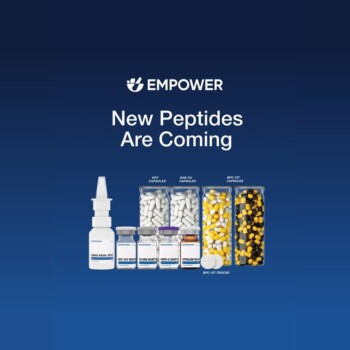
New Peptide Preparations Are On The Way
About the Authors
Jean Cunningham, PharmD, BCPS, is Senior Director of Medical Affairs at Empower Pharmacy, where she leads efforts to build clinical education, provider engagement, and evidence-based medical information for integrative and personalized medicine. She has more than 20 years of experience in Medical Affairs, scientific communications, and women’s health.
Alana Leavell, APRN, FNP-C, is a Clinical Application Liaison at Empower Pharmacy, where she leads efforts to build prescriber and patient empowerment through clinical education and provider support. She focuses on identifying unmet needs among providers and patients and helping them lean into individualized patient care. She has more than 17 years of clinical experience, including 10 years practicing individualized medicine.
Disclaimer
Compounded products are not FDA-approved and have not been evaluated by the FDA for safety or efficacy. Compounded products from our 503A facility are available only through a valid patient-specific prescription from a licensed prescriber and are prepared by a licensed pharmacy; shipping and state restrictions may apply. Compounded drug products from our 503B facility are only available for order by licensed healthcare providers and pharmacies. This document is for educational and informational use by healthcare professionals. It is not medical, legal, or regulatory advice, and it is not a promotion of any product. Except for products identified as currently available, it is not a statement of product availability.
Regulatory status
HHS’s interim policy is an expression of enforcement intent under stated conditions; it does not approve any product, change the requirements of the FD&C Act, or place any substance on the 503A Bulks List, which requires FDA rulemaking. PCAC recommendations are advisory. No dose of this product has been established as safe or effective in humans. State boards of pharmacy and medicine independently regulate compounding and prescribing. Regulatory status can change; confirm current status with FDA, HHS, and applicable state authorities before relying on this summary.
Reporting
Healthcare professionals and patients are encouraged to report suspected adverse events and product quality concerns to FDA MedWatch (fda.gov/medwatch; 1-800-FDA-1088).
Sources
How we sourced this: Every policy statement comes from the HHS policy document, the Federal Register, or FDA.
- US Department of Health and Human Services. Enforcement discretion policy regarding 503A compounding using certain peptide bulk drug substances, including Appendices A and B. Accessed November 2, 2026. https://www.hhs.gov/sites/default/files/hhs-503a-peptide-enforcement-discretion-policy-appendix-b.pdf
- Food and Drug Administration. Bulk drug substances used in compounding under section 503A of the FD&C Act. Accessed November 2, 2026. https://www.fda.gov/drugs/human-drug-compounding/bulk-drug-substances-used-compounding-under-section-503a-fdc-act
- Food and Drug Administration. Pharmacy Compounding Advisory Committee; notice of meeting; establishment of a public docket; request for comments. Fed Regist. 2026;91(73). Published April 16, 2026. FR Doc 2026-07361. Docket FDA-2025-N-6895. Accessed November 2, 2026. https://www.federalregister.gov/documents/2026/04/16/2026-07361/pharmacy-compounding-advisory-committee-notice-of-meeting-establishment-of-a-public-docket-request
- Food and Drug Administration. July 23-24, 2026: meeting of the Pharmacy Compounding Advisory Committee. Accessed November 2, 2026. https://www.fda.gov/advisory-committees/advisory-committee-calendar/july-23-24-2026-meeting-pharmacy-compounding-advisory-committee-07232026
- US Department of Health and Human Services. Enforcement discretion policy regarding 503A compounding using certain peptide bulk drug substances; notice of availability. Fed Regist. Published October 30, 2026. FR Doc 2026-22192. Docket HHS-OASH-2026-0496. Accessed November 2, 2026. https://www.federalregister.gov/d/2026-22192