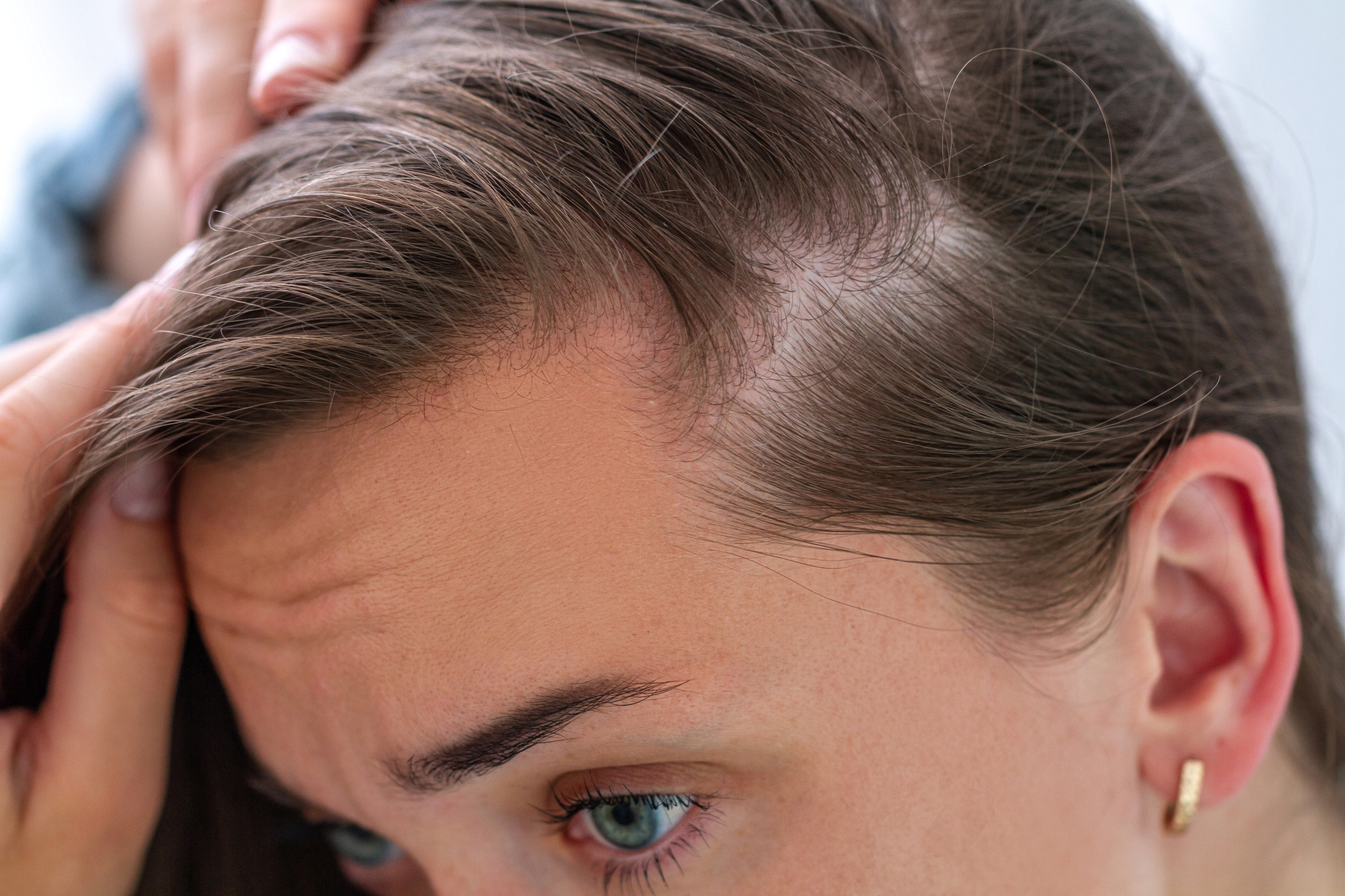
Quick answer: GLP-1 hair loss is usually a condition called telogen effluvium, a temporary disruption of the hair growth cycle caused by rapid weight loss rather than by the medication attacking the hair follicle directly. Shedding tends to begin three to six months after starting semaglutide or tirzepatide and typically resolves within six to twelve months as weight stabilizes. Topical minoxidil currently has the strongest supporting evidence among available treatments. The FDA first recognized potential signals of alopecia associated with FDA-approved GLP-1s in its quarterly report for July-September 2023. The “Adverse Reactions” section of the labeling for FDA-approved medications containing tirzepatide and semaglutide was updated between December 2024 and May 2025 to include alopecia.
Do GLP-1s cause hair loss? Understanding the connection
Hair cycles through a multi-year growth phase, called anagen, and a brief resting phase, called telogen, before it sheds. A major physical stressor, such as a fever, surgery, childbirth, or a large and rapid drop in body weight, can push an unusually high share of hairs into that resting phase at once. Because those hairs fall out together months later, the result looks like sudden, diffuse thinning.1
This mechanism, called telogen effluvium, best explains the hair loss reported by patients using glucagon‑like peptide-1 (GLP-1) receptor agonists — including semaglutide and tirzepatide.2 Semaglutide and tirzepatide are linked to hair loss reports far more often than older GLP-1 medications like liraglutide, and reports increase as the percentage of body weight lost increases, especially at losses of 20% or more. That pattern supports the idea that the underlying metabolic shift, not a distinct property of either molecule, drives the association.4
Who is impacted by GLP-1 associated hair loss, and how long does it typically last?
Hair loss affects a minority of GLP-1 users, and women make up most reported cases. Risk appears higher for patients who lose weight quickly, have a family history of thinning hair, or are not getting enough protein and key nutrients during rapid weight loss.4 Shedding usually peaks two to four months after the triggering weight change and eases on its own as weight stabilizes, even if the patient stays on the medication. Most cases resolve within six to 12 months. A smaller group, often those with an underlying tendency toward androgenetic alopecia, may see more lasting thinning that benefits from active treatment.5,6
Hair shedding treatment options that actually help
Topical minoxidil. Minoxidil is the only FDA-approved treatment for female pattern hair loss and carries the strongest evidence base available to women. A Cochrane review found women using minoxidil were roughly twice as likely to see moderate regrowth compared with placebo.7 Both the 2% and 5% over-the-counter strengths work, though the higher strength causes more scalp irritation and unwanted facial hair in some patients.8 A short increase in shedding after starting minoxidil is expected, since it also shifts follicles into a new growth phase before it helps.9
Finasteride and other antiandrogens. Finasteride lowers the hormone most closely tied to pattern hair loss. It is FDA-approved for men only, and it carries a critical restriction for women: it must never be used, or even handled as a broken or crushed tablet, by anyone who is pregnant or may potentially be pregnant, due to the risk of birth defects in a male fetus. Standard dosing also shows weak evidence in postmenopausal women. When antiandrogen therapy is appropriate, spironolactone is more commonly used for women of reproductive age, with finasteride reserved for select postmenopausal patients under close supervision.8,10
Tretinoin. Tretinoin supports rather than treats telogen effluvium on its own. Its main role is improving how well the scalp absorbs minoxidil when the two are combined for pattern hair loss. Tretinoin should be avoided in patients who are pregnant or breastfeeding.11
Compounded, provider-directed options. Compounding pharmacies can create custom medications that are not available as standard commercial products pursuant to a patient-specific prescription from a licensed healthcare provider. For example, compounding pharmacies can prepare topical scalp products that combine multiple ingredients into a single formula. These products, sometimes called hair restoration formulas, may include minoxidil, azelaic acid, and, in some cases, finasteride, when a healthcare provider determines that the combination is appropriate for a specific patient.
Healthcare providers may also prescribe compounded GHK-Cu, a copper peptide available as a customized topical product. Although GHK-Cu is not an FDA-approved drug, early laboratory research and small human studies suggest it may help support hair follicle health. Researchers believe it may improve blood flow to the scalp, help hair follicles remain in the growth phase longer, and reduce scalp inflammation. These effects could complement established treatments such as minoxidil and finasteride rather than replace them.12 Any decision to initiate, pause, or continue any treatment, including a GLP-1 medication, belongs to the prescriber and patient.
Discover Our Dermatology Portfolio
Frequently asked questions about GLP-1 hair loss
Do GLP-1s cause hair loss?
Hair loss is a recognized but uncommon side effect linked to GLP-1s. It usually reflects telogen effluvium triggered by rapid weight loss, not a direct effect on the scalp.2
Is GLP-1 associated hair thinning permanent?
Hair thinning typically improves within six to twelve months as weight stabilizes.5,6 Some patients with an underlying predisposition to pattern hair loss may need ongoing treatment.
What is the best hair shedding treatment?
Only a licensed healthcare provider may determine the best treatment that should be prescribed for a specific patient based upon the individual’s clinical history. Topical minoxidil has the strongest evidence for women overall. A prescriber may add finasteride, spironolactone, or a compounded combination formulation based on the pattern of loss and patient-specific clinical factors. 4,8,10
Should I stop my GLP-1 medication if my hair is falling out?
A patient should consult the prescribing healthcare provider for guidance so that they may make an informed decision together. Many patients continue their GLP-1 medication while treating the hair loss simultaneously.
Can men lose hair on semaglutide or tirzepatide, too?
Both men and women may experience hair loss while taking a GLP-1, though reported cases skew heavily toward women.2 The same rapid-weight-loss mechanism applies to men, and those with a genetic tendency toward pattern hair loss may see it progress faster.
Disclaimer: This article is educational and is not medical advice. Empower Pharmacy is a compounding pharmacy, not a medical practice, and cannot diagnose or treat you. Talk with your health care provider before changing any medication or treatment. References cited in this article are associated with FDA-approved GLP-1s. Compounded drug products are not FDA-approved or evaluated for safety or efficacy. Compounded drug products from our 503A pharmacy are only available pursuant to a patient-specific, valid prescription from a licensed healthcare provider. Compounded drug products from our 503B facility are only available for order by licensed healthcare providers.
- Natarelli N, Gahoonia N, Sivamani RK. Integrative and Mechanistic Approach to the Hair Growth Cycle and Hair Loss. J Clin Med. 2023;12(3):893. Published 2023 Jan 23. doi:10.3390/jcm12030893.
- Tang H, Zhang B, Lu Y, Zhang D, Liu R, Lu Y et al. Risk of hair loss associated with glucagon-like peptide-1 receptor agonists in adults with type 2 diabetes: target trial emulation BMJ 2026; 394 :e100077 doi:10.1136/bmj-2026-100077
- List JF, He H, Habener JF. Glucagon-like peptide-1 receptor and proglucagon expression in mouse skin. Regul Pept. 2006;134(2-3):149-157. doi:10.1016/j.regpep.2006.02.007.
- Gupta AK, Teasell EM, Economopoulos V, Mirmirani P. GLP-1 therapies and hair loss: A systematic review of current evidence and implications for counseling. Sci Prog. 2026;109(2):368504261444578. doi:10.1177/00368504261444578.
- Zarabian N, Farah M, Stines A, Friedman A. The Role of Glucagon-Like Peptide-1 Receptor Agonists in Hair Loss: Clinical Evidence and Proposed Mechanisms. Dermatol Surg. 2026;52(6S):S67-S71. doi:10.1097/DSS.0000000000005176.
- Lee N, Kim Y. Not All GLP-1 Receptor Agonists Are Alike: Real-World Evidence of Differential Endocrine and Dermatologic Safety. Diabetes Metab Res Rev. 2026;42(4):e70163. doi:10.1002/dmrr.70163.
- van Zuuren EJ, Fedorowicz Z, Schoones J. Interventions for female pattern hair loss. Cochrane Database Syst Rev. 2016;2016(5):CD007628. Published 2016 May 26. doi:10.1002/14651858.CD007628.pub4.
- Nestor MS, Ablon G, Gade A, Han H, Fischer DL. Treatment options for androgenetic alopecia: Efficacy, side effects, compliance, financial considerations, and ethics. J Cosmet Dermatol. 2021;20(12):3759-3781. doi:10.1111/jocd.14537.
- Bi L, Kan H, Wang J, et al. Whether the transient hair shedding phase exist after minoxidil treatment and does it predict treatment efficacy? A retrospective study in androgenetic alopecia patients. J Dermatolog Treat. 2025;36(1):2480739. doi:10.1080/09546634.2025.2480739.
- Olsen EA. Hair Loss in Women. N Engl J Med. 2025;393(15):1509-1520. doi:10.1056/NEJMcp2412146.
- Balado-Simó P, Morgado-Carrasco D, Gómez-Armayones S, et al. An Updated Review of Topical Tretinoin in Dermatology: From Acne and Photoaging to Skin Cancer. J Clin Med. 2025;14(22):7958. Published 2025 Nov 10. doi:10.3390/jcm14227958.
- Liu T, Liu Y, Zhao X, et al. Thermodynamically stable ionic liquid microemulsions pioneer pathways for topical delivery and peptide application. Bioact Mater. 2023;32:502-513. Published 2023 Nov 1. doi:10.1016/j.bioactmat.2023.10.002.